Friday, September 28, 2007
Politicians and popular music
Tuesday, September 25, 2007
Natal'ia Pivovarova (1963-2007)
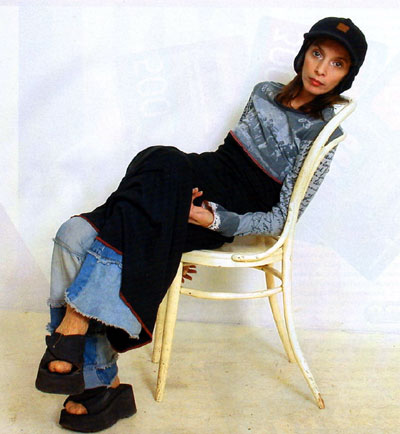
Yet another influential musician passed away. Monday, September 24th, 2007 one of Kolibri's founders, Natal'ia Pivovarova, died in a car crash on the Krim. Born July 17th, 1963 in Novgorod Pivovarova was active in Sergei Kurekhin's Pop Mekhanika before founding Kolibri in 1988/89. During her tenure with the group they released 6 albums. Kolibri has become a central band in the Post Soviet musical scene and pioneered being an only female band (other important contemporary all female groups are Babslei and Iva Nova - however they emerged later and Babslei is no longer an all female band). Leaving the group in 1998 to focus on a solo career Pivovarova founded the group Sous in 2000. She also became more focused on the theatre.
I heard her perform at the now defunct club Platforma on April 29th, 2005. The style was soft-rock/popish and the melodic-harmonic material had some allusions to other songs (like "Hit the road Jack"). Her singing was slightly rough (it was quite audible that she smoked) and often out of tune. In contrast, the backup vocalist had a nice, jazzy style voice and the instrumentalists (Percussion, Bass, Drums, Blues Guitar and Djembe) grooved. The gig also had a theatrical side to it (this was the bizarre part). Pivovarova started the gig in a black rain coat wearing sunglasses and walked around the stage with an umbrella. Under the rain coat she had a very short dress. After about 45 min she then stripped down to her bikini which had a cow pattern on it... Towards the end of the concert two girls dressed as cheerleaders appeared and danced on the dance floor. Pivovarova both between and during songs also small talked a lot to the audience - cursing a lot and once also threatening not sing if nobody danced
(Sasha, the singer in Svoboda also did that sometimes). All in all the concert deviated from my "normal" concert experiences in Piter and the event stuck in my mind...For more information about the accident check www.rian.ru/review/20070925/80785389.html (in Russian). For more information about Natal'ia Pivovarova and Kolibri check out Kolibri's homepage and their encyclopedia entry in rock-n-roll.ru (both in Russian). There are a lot of obituaries online like the Russian version of Rolling Stones or the blog Rock meloman (just do a google search if you want more).
Наталья Пивоварова (1963-2007)
(русская версия - адаптирована Sergio Mazzanti)
друг к другу. В концерте была предусмотрена и театральная сторона (это была причудливая часть). Пивоварова начала концерт в черном дождевом плаще и солнечных очках и ходила по сцене с зонтиком. Под дождевым плащом она одевала очень узкую одежду. После минут 45 она разделась до бикини, похожего на коровью кожу... К концу концерта появились две девушки одеты как спортивная группа поддержки и поплясали на танцплощадке. Между и во время песен Пивоварова болтала с публикой, много материлась и однажды даже угрожала перестать петь, если никто не танцует (Саша, певец в Свободе, иногда тоже так делал). Во всяком случае концерт отклонялся от моего концертного опыта в Питере и событие осталось в моей голове.Friday, September 21, 2007
A summary on Rock Music in Russia
The site http://www.russia-ic.com/ features a section on Russian music, including two genres that can be considered “popular music”: Author’s song (avtorskaia pesnia) and Rock music.It’s not easy to mark precise boundaries between these two genres; e.g. Aleksandr Bashlachev is presented in author’s song, even if a lot of critics consider him a representative of Rock music: “He was the first to join rock music and the poetic nerve”.
In spite of some factual mistakes (e.g. the Leningrad rock club opened in 1981 and not in 1982) and some not very convincing statements (e.g. Chaif as a group with particular interest for Russian folklore tradition), the short History of Rock Music in Russia has a quite multilateral approach to the question and avoids fixed cliches.
Furthermore, they also have a section on Punk Rock & Alternative Rock in Russia (taken, indeed, from the Russian wikipedia) and on The legends of Russian Rock Music, where they briefly describe the most well-known Russian bands.

People searching for a more detailed and academic history of soviet rock, especially in Leningrad, should read Yngvar Steinholt’s “Rock in the Reservation” (the book can be ordered from amazon).
Краткая история рок-музыки в России по-английски
В сайте http://www.russia-ic.com/ находится секция о русской музыке , в том числе о двух жанрах, приписываемых «популярной музыке»: Авторская песня и Рок-музыка.

Не легко провести четкие границы между этими двумя жанрами: таким образом Александр Башлачев приписывается авторской песне, хотя многие критики считают его представителем рок-музыки: «Он был первым, который соединял рок-музыку и поэтический нерв».
Несмотря на некоторые фактические ошибки (например, Ленинградский рок-клуб открылся в 1981-м году, а не в 1982) и не очень убедительные высказывания (Чай-ф как группа, интересующаяся фольклорной традицией), краткая История рок-музыки в России подходит к теме довольно многосторонне и избегает установленные клише.
Кроме того, можно найти также страницу о панк-роке и альтернативном роке в России (правда, взята из википедии) и о легендах русской рок-музыки , где в двух словах описываются самые известные русские рок-группы.
Для тех, кто ищет более детальную и научную историю советского рока по-английски, особенно в Ленинграде, рекомендуется книга Ингвара Штейнголта “Rock in the Reservation”.
Tuesday, September 18, 2007
Russkaia Rok-Poeziia 9
Русская рок-поезия 9
(русская версия – адаптирована Sergio Mazzanti
Wednesday, September 12, 2007
Another article on russkii rok
In this short article Davydov touches such complicated topics like if the concept of “Russian rock-poetry” exists and if it is at all possible to define rock. The article is not based on scientific research and, of course, does not pretend to exhaust the whole subject, but it contains some interesting moments: Davydov indicate the importance of considering the musical part of any rock-work; the author also advances the very simple, but by no means universally accepted idea, that it is impossible to speak about Russian rock-poetry without defining what “Russian rock-poetry” is.
Другая статья о русском роке
Я хотел указать нашим читателям недавно вышедшую в Журнале «Арион» статью Данилы Давыдова «В поисках утраченного рока». Автор предлагает некоторые рассуждения, которые несколько выходят из общепринятого сегодня взгляда на «русский рок»; недаром статья посвящена памяти одного из самых «альтернативных» русских рок-журналистов (не считаясь с его важнейшей деятельностью, как рок-поэт): Илья Кормильцев, который четвертого февраля текущего года скончался от рака позвоночника в Лондоне.
В этой небольшой статье Давыдов касается таких сложных тем, как: существует ли понятие русской рок-поэзии и возможно ли определенить рок, как таковой. Статья не является научным исследованием и, само собой разумеется, не претендует исчерпать предмет, но она содержит некоторых интересных моментов: Давыдов указывает на важность учитывать музыкальную сторону любого рок-произведения; автор также выдвигает очень простую, но далеко не общепринятую мысль о том, что не возможно говорить о русской рок-поэзии, не определив что это такое «русская рок-поэзия».
Tuesday, September 11, 2007
New rock encyclopedias
The St. Petersburg rock critic and editor of rock-n-roll.ru Andrei Burlaka just finished a three volume rock encyclopedia focusing on popular music in Leningrad and St. Petersburg: "Rok Entsiklopediia - Populiarnaia muzyka v Leningrade-Peterburge 1965-2005", Amfora 2007 (the announcement can be found at rock-n-roll.ru) - so far the first two volumes have been released. Interestingly, the articles in the encyclopedia can also be found online at rock-n-roll.ru (seemingly in the same version).
The entries span "classic" and current groups until 2005, the book's deadline (e.g. Akvarium, Voskresenie, Mify, Reggistan, Iva Nova and Billy's band) as well as individual musicians (e.g. Vsevolod Gakkel', Anatolii "Dzhordzh" Gunitskii, Aleksandr Liapin, Sergei Kurekhin - mostly people linked to the Leningrad Rock Club / from the 1980s). Popular music more accurately defines the styles, since Burlaka not only includes "pure" rock groups, but also cross over projects (e.g. Ole Lukoie, Vermicelli Orchestra, Lia Minor). The articles of varying length include discographies and place the mentioned groups within a wider rock lineage listing other projects the members have been involved in. Pictures from both Burlaka's personal collection as well as from other photographers are also included, however, they have not always been scanned in the best quality / resolution...
All in all the encyclopedias are a worthwhile reference to have if you like owning books and want the pictures. The hard copy is also more secure than the online version, especially since a lot of the site's entries were lost while rock-n-roll.ru migrated to their current server...
Sunday, September 9, 2007
Ska in Piter
The music style ska (in its different forms) has become increasingly popular in St. Petersburg, Moscow and also in the Ukraine, at least judging by some of the music I have heard (the rest of Russia is kind of hard to judge since I do not really have any ethnographic material). Ska originated in Jamaica and is closely related to the music style reggae. Rhythmically what roughly characterizes ska are accents on the second and fourth beat. The basic line up is at least a rhythm section (Guitar, Bass, Drums and Vocalist) and a horn section with at least a Trumpet or Saxophone."There are pioneers and copy-cats and once Leningrad was so big/famous... For a lot of people it was a revelation, a discovery, that such a musical direction [ska] existed and at that time Shnurov [Leningrad's singer], I think, had been telling [people] on his home-page about ska - what it is and such - and Spitfire as well, well the band, that always [has played] ska, he also advertised for them. [...] I think that a lot of people simply found out about ska through Leningrad and then the idea to play just that, because it is currently well received."
(Interview with Yuriy Gurzhy. Berlin, 05.10.05 - my translation)
During my stay in St. Petersburg there were quite a few bands playing ska-related music , e.g. Svoboda, the band I played in (and you guessed it, one of the models for Svoboda was/is Leningrad), Banana Gang, Brosound, Beshenye Ogurtsy, Dva Samoliota, No Guns, Porto Franco and St-Petersburg Ska-Jazz Review.
But, more interesting than the history of ska in Russia, is what people (in Russia) think and say about ska. Talking about how ska appeared in St. Petersburg Andrei Burlaka added that nobody in Russia plays like the original ska artists. The local groups play more specific Russian versions (like ska-punk). Andrei Ivanov, the vocalist in the St. Petersburg reggae group Reggaestan, said in an interview that ska derived its popularity from punk, which was and still is popular in Russia. He explained that Russians like to drink and when they are drunk they like to move, jump (skakat') and push/shove (tolkat'), which ska and punk encourage. He added that reggae which is related to ska is not so popular in Russia, because it is more profound, slower, and with a different energy. Andrei Burlaka noted that it is too cold to play "Southern music", like ska in Russia, and that this is why the groups play a mixture (like ska-punk). Aleksandr Kasparov, one of the directors of the Berlin record label Eastblok Music specialized in Easter European music, said the following about the popularity of ska:"For the Russians I think that is a good rhythm, good music, and [it] has to do with the Russian rhythm, with Chastushka or with all others... It's not too foreign for Russian ears this ska rhythm."
(Interview with Alexander Kasparov. Berlin, 19.07.2006 - my translation)
While these views can be discussed as stereotypical they do demonstrate that ska has become an inherent part of Post Soviet popular music and that the listeners are trying to appropriate the style as not only foreign, but something which also has its roots in Russia (but in a different previous form).
Ска в Питере
(русская версия - адаптирована Sergio Mazzanti)
Музыкальный стиль ска (в его разновидностях) стал все больше и больше популярным в Санкт-Петербурге, Москве и также в Украине, по крайней мере судя по той музыке, которую я послушал (об остальной части России как-то нелегко судить, поскольку на самом деле у меня нет этнографического материала). Ска возник в Ямайке и тесно связан с музыкальным стилем регги. Ритмически то, что характеризует ска – ударения на втором и четвертом тактах. В основную линию входят по крайней мере ритм-секция (гитара, бас-гитара, ударные и вокалист) и духовая секция по крайней мере с трубой и саксофоном.
Во время интервью музыкальный критик Андрей Бурлака (он крутит очень информированный сайт rock'n roll.ru) сказал мне, что ска появился в России вместе с битловской песней «Облади облада». Большинство людей, с которыми я разговаривал, согласны с тем, что первая группа, играющая ска в России была ленинградская группа «Странные игры», которая дебютировала в 1982 г. (один человек сказал, однако, что Гарик Сукачев был пионером ска). Ска не был, однако, очень популярен в восьмидесятые годы и немногие группы включали его в свой репертуар. Стиль испытал подъем популярности в 1990-ые годы, когда люди начали путешествовать и больше подвергались влиянию западной популярной музыки (известные ска-группы, такие как Skatalites, гастролируют в России). Spitfire и Distemper были из первых групп, играющих и затем делающих ска (смешенный с панком) популярным. Однако, сегодняшняя популярность связана наверное с известной группой «Ленинград» (основанной в 1997 г.):
«Были пионеры и были подражатели и едва Ленинград был такой большой... Для многих это было откровение, открытие, что было такое музыкальное направление и тогда Шнуров [певец Ленинграда], я думаю, тоже рассказывал в своем сайте о ска, что это такое и как, и еще Spitfire, как группа всегда [играющая] ска, они тоже широко тогда рекламировались. Я думаю, что через Ленинград многие прямо пришли к ска и затем к идее, именно это играть, потому что на данный момент это хорошо воспринимается» (интервью с Юрием Гуржием. Берлин, 05.10.05 – перевод Sergio Mazzanti).
Во время моего пребывания в Санкт-Петербурге было немало групп, играющих музыку связанную со ска, т.е. Svoбода, группа в которой я играл (и, угадайте, одна из моделей для Свободы была и есть Ленинград), Banana Gang, Brosound, Бешеные Огурцы, Два Самолета, No Guns, Porto Franco и St-Petersburg Ska-Jazz Review.
Но интереснее истории ска в России это то, что люди (в России) думают и говорят по поводу ска. Разговаривая о том, как ска появился в Санкт-Петербурге, Андрей Бурлака добавил что в России никто не играет так, как оригинальные ска-артисты. Местные группы играли более специфически русские версии (как ска-панк). Андрей Иванов, вокалист в Санкт-Петербургской регги-группе РеггиСтан, сказал в интервью, что ска достает популярность из панка, популярного жанра в России в прошлом и настоящем. Он объяснил, что Русские любят выпить и когда они пьяны, они любят двигаться, скакать и толкать, что ска и панк способствуют. Он добавил, что связанный со ска регги не очень популярен в России, потому что он глубже, медленнее, и с другой энергией. Андрей Бурлака заметил, что в России слишком холодно, чтобы играть «Южную музыку» как ска, и что по этой причине группы играют смесь (как ска-панк). Александр Каспаров, один из директоров рекорд-компании Eastblok Music, специализированной в западно-европейской музыке, сказал следующее о популярности ска:
«Я думаю, для русских, это хороший ритм, хорошая музыка, и имеет что-то общее с русским ритмом, с Частушкой или со всеми остальными... Это не так чуждо для русских ушей, этот ска-ритм» (интервью с Александром Каспаровым. Берлин, 19.07.06 – перевод Sergio Mazzanti).
Хотя эти мнения могут быть восприняты как стереотипическими, они доказывают, что ска стал неотъемлемой частью постсоветской музыки и что слушатели пытаются присвоить стиль, не только как иностранный, но как нечто имеющее свои корни в России (но в другой форме).
English site on Russki pop
Английский сайт о русской попсе
Для тех, кто любит русскую попсу, есть неплохой, хотя не очень активный сайт на английском языке:
http://www.russkipop.com/